Pick and pack warehousing: The complete guide to faster, more accurate fulfilment
Table of contents
Share
Order picking accounts for over 55% of total warehouse operating costs (Taylor & Francis, 2023). That's more than space, utilities, and admin combined. So if you're trying to find margin in your fulfilment operation, the place to look isn't your storage bill. It's the time a picker spends walking, the accuracy rate at the packing bench, and the picking method you chose two years ago and haven't revisited since.
Global ecommerce retail sales are projected to hit $6.88 trillion in 2026, around 21.1% of all retail (Capital One Shopping, 2025). The brands that win in that volume aren't the ones with the cheapest warehouse. They're the ones with the most accurate, fastest pick and pack process. Everyone else absorbs the cost of returns, reships, and churn.
This guide covers what pick and pack warehousing actually is, the four main methods used in modern warehouses, how to benchmark your accuracy, real cost data by volume tier, and a clear framework for deciding whether to keep it in-house or hand it to a Third-Party Logistics provider.
What is pick and pack warehousing?
Pick and pack is a fulfilment process in which warehouse workers (or automated systems) retrieve individual SKUs from storage locations and prepare them into shipping-ready parcels. It's the central part of every ecommerce order: from the moment a customer clicks 'buy' on their phone or computer, to the moment a parcel leaves the loading dock; pick and pack is what's happening in the middle.
It's distinct from bulk or wholesale fulfilment, where a warehouse pulls full pallets or cases of a single SKU. Pick and pack is built for the messier reality of direct-to-consumer orders: one customer wants a small T-shirt, a phone case, and a sticker pack, all in one parcel, dispatched today.
The ecommerce fulfilment services market was valued at $141.35 billion in 2025 and is projected to reach $468.44 billion by 2034 at a 14.24% CAGR (Precedence Research, 2025). The broader warehousing market sits at around $523–536 billion in 2024, projected to reach $716–919 billion by 2033 (Grand View Research, 2024). That growth isn't theoretical. It's the result of consumer expectations that have hardened around two-day, next-day, and same-day delivery as standard.
The pick and pack workflow follows four sequential steps: receive, pick, pack, and ship. Each step has its own KPIs, its own failure modes, and its own opportunities to add cost or shave it. Get one step wrong and the downstream effect compounds. A mislabelled inbound shipment in step one becomes a wrong-item pick in step two, a returned parcel in step five, and a customer who buys elsewhere next time.
For ecommerce brands, this matters because it's the operational layer customers actually experience. They don't see your warehousing and fulfilment services contract. They see whether their order arrived on time, in one piece, with the right items in the box. Pick and pack is where that customer experience is built or broken.
The 4 steps of the pick and pack process
The pick and pack process follows four sequential steps: order receipt, item picking, order packing, and shipment. Each has measurable KPIs that separate top-performing warehouses (99.5%+ accuracy) from the industry average (97–99%).
Step 1: Order receipt
A customer places an order on Shopify, Amazon , or a marketplace. The order flows into the warehouse's management system, which assigns it to a picker or a picking wave, generates a pick list, and routes it to the correct zone. The KPI here is order-to-pick-start time. Best-in-class operations are picking within minutes of order placement.
Step 2: Picking
A worker (or robot) retrieves the items from their storage locations. Typical pick rate is around 71.42 picks per hour, with a range of 50–150 depending on warehouse layout, picking method, and technology (Staci Americas, 2024). This is where most errors enter the process: wrong SKU, wrong quantity, wrong variant.
Step 3: Packing
Picked items move to a packing station, where they're verified against the order, packaged in the appropriate box or mailer with the right protective material, weighed, and labelled. Packing is also where dimensional weight gets locked in, which directly affects shipping cost.
Step 4: Shipment
The packed parcel is sorted by carrier, scanned, and handed off. The KPI here is dispatch cut-off compliance. A parcel that misses the carrier's daily pickup adds a full day to delivery time.
The cost split across these four steps isn't even. Picking dominates everything else.
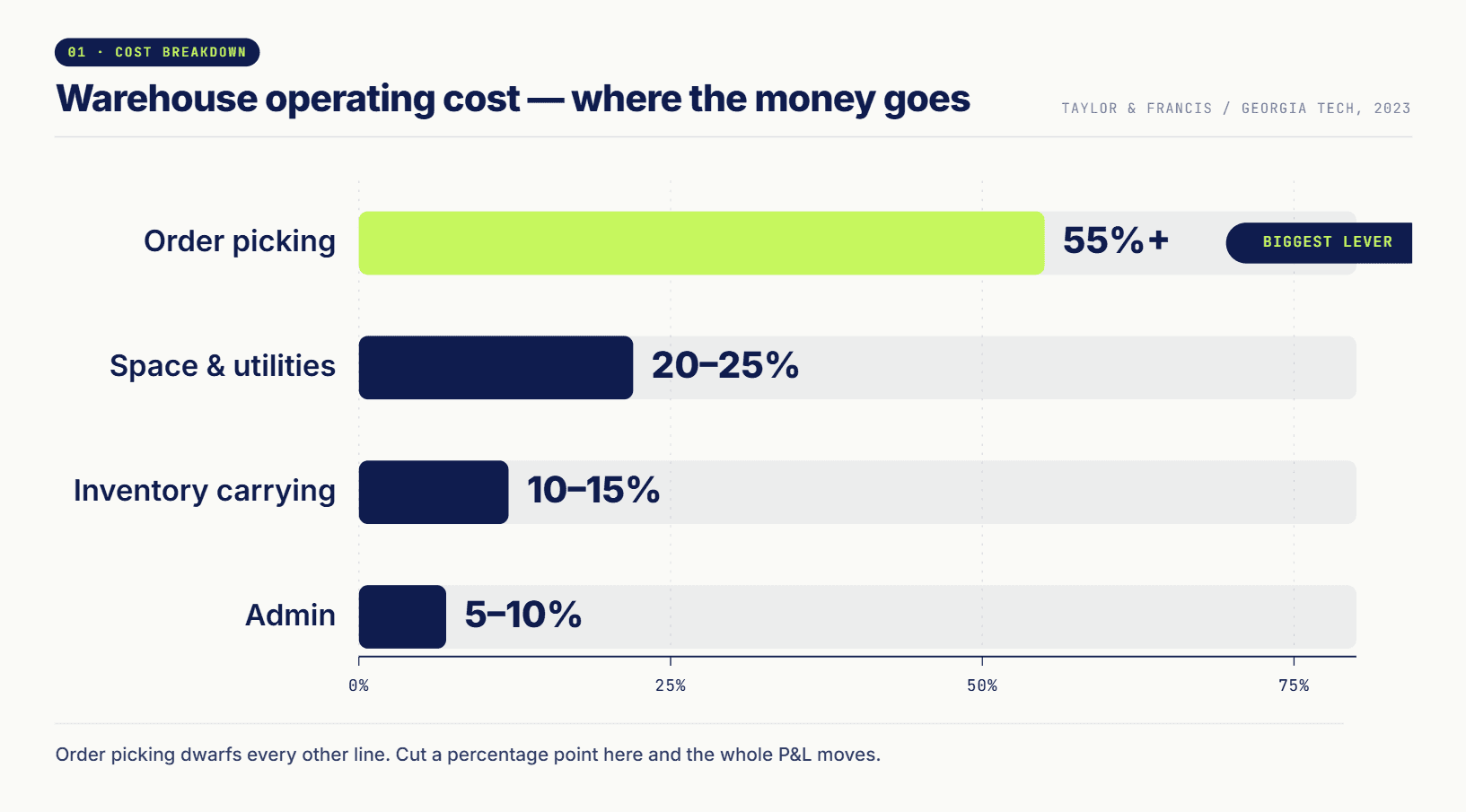
If you're trying to reduce fulfilment cost, this chart tells you where to start. A 10% improvement in picking efficiency moves more money than a 10% improvement anywhere else on the chart.
The 4 main pick and pack methods explained
The four warehouse picking methods (piece, batch, zone, and wave) vary in efficiency by order volume and SKU count. Choosing the wrong method at scale is one of the leading causes of the 1–3% error rate that's typical across the industry (Canadian Alliance, 2024).
1) Piece picking (also called single-order picking)
One worker picks one order at a time, walking the warehouse to retrieve every item on the pick list before moving to the next order. It's the simplest method and the easiest to train staff on.
Best for: Low order volume (under 50 orders/day), highly customised products, fragile or high-value SKUs that need careful handling.
Trade-off: Walking time dominates the pick. At scale, your pickers spend more time travelling than picking, and your cost per order climbs fast.
2) Batch picking
One worker picks multiple orders simultaneously, retrieving items for several orders in a single pass through the warehouse, then sorting them at a downstream station.
Best for: Mid-volume operations (50–200 orders/day) with overlapping SKUs across orders. Particularly strong when the same item appears in lots of orders.
Trade-off: Sortation accuracy becomes the bottleneck. Batch picking moves the error risk from the pick aisle to the sort station.
3) Zone picking
Workers are assigned to specific zones of the warehouse. Each order passes through the zones it needs, with each zone-worker picking only the items in their area.
Best for: Large warehouses with 500+ orders/day and clearly defined product categories.
Trade-off: Orders that span many zones move slower because they wait for each zone to add to them. Works best when you can engineer zone overlap by SKU velocity.
4) Wave picking
Scheduled batches of orders are released across zones at set intervals (waves) throughout the day, usually aligned with carrier cut-off times.
Best for: High-volume, multi-channel operations that need to coordinate dispatch with carrier pickups, marketplace cut-offs, and SLA commitments.
Trade-off: Requires sophisticated WMS integration and tight planning. When it's running well, it's the most efficient method at scale. When it's not, it amplifies every error.
Over 35% of warehouses experience a picking error rate of 1% or more (Staci Americas). The single most common reason isn't lazy pickers or bad SKUs. It's a method-volume mismatch: a warehouse running piece picking at 1,000 orders per day, or running wave picking at 80 orders per day with no real coordination need.
Pick and pack accuracy: benchmarks, costs, and how to improve
Best-in-class pick and pack operations achieve 99.5%+ accuracy. The industry average is 97–99%, meaning 1–3 errors per 100 orders (Canadian Alliance, 2024). On small order volumes, those numbers look fine. They aren't.
For a warehouse processing 500,000 annual orders, moving from 97% to 99.5% accuracy eliminates approximately 12,500 mis-packs per year. Each one of those is a return, a reship, a customer service ticket, a chargeback risk, and a potential lifetime-value loss. At an average resolution cost of $20–$30 per mis-pack (shipping reversal, replacement, support time), that's $250,000–$375,000 a year in operational expenditure that disappears the moment your accuracy rate moves two and a half points.
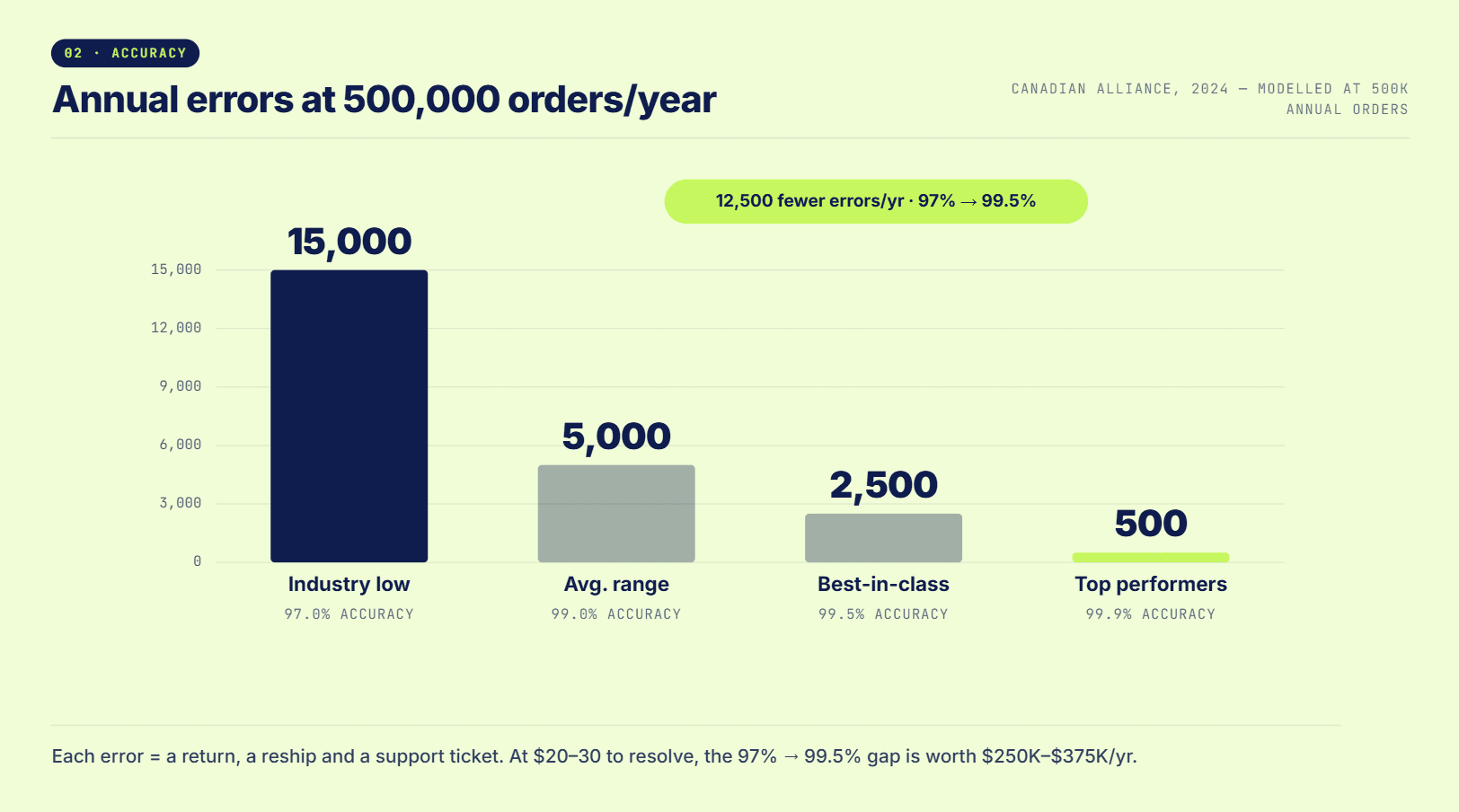
The accuracy curve isn't linear. The gap between 97% and 99% saves you 10,000 errors a year. The gap between 99% and 99.5% saves you another 2,500. The gap between 99.5% and 99.9% saves another 2,000. The marginal cost of accuracy improvements rises sharply at the top end, which is why most warehouses settle at the 99.0–99.5% range. Going beyond that requires meaningful capital investment.
What causes pick errors
SKU look-alike: Two products that look similar in the bin (size variants, colour variants, packaging that's been refreshed but not on every unit).
Bin location errors: An item put away in the wrong slot during receiving.
Quantity miscounts: Particularly common when picking small items by handful rather than scanning each unit.
Order substitution: Picker grabs the next SKU on the list and accidentally pulls from the previous order's bin.
Label mix-ups at packing: The correct items end up in a parcel with the wrong shipping label.
Technologies that improve accuracy
Three tiers of investment, three step-changes in accuracy:
Barcode scanning at pick and pack: The baseline. Every reputable warehouse runs this. Moves accuracy from ~95% (manual paper picks) to ~99%.
Pick-to-light or put-to-light: Visual indicators at bin locations show the picker where to go and how many to pick. Strong on accuracy and pick speed for high-velocity SKUs. Adds capital cost.
Voice-directed picking: Picker wears a headset, hears instructions, confirms verbally. Frees up hands and eyes, particularly useful in cold storage or freezer environments. Accuracy regularly above 99.5%.
The provider you work with matters more than the technology itself. A warehouse running barcode-only with strong process discipline routinely outperforms one with pick-to-light and weak supervision.
How much does pick and pack fulfilment cost?
Pick and pack costs $2.50–$5.00 per order for small to mid-sized businesses using a 3PL provider, with storage running $7–$15 per pallet per month (Red Stag Fulfilment, 2025). The average B2C pick and pack service fee is $4.05 per item.
B2B pick and pack runs 49.2% more expensive than B2C due to compliance labelling, larger order quantities, EDI requirements, and retailer routing guides (Capital One Shopping Research, 2026). If you're shipping to Target, Walmart, or Costco, you're paying that premium whether you operate in-house or outsource.
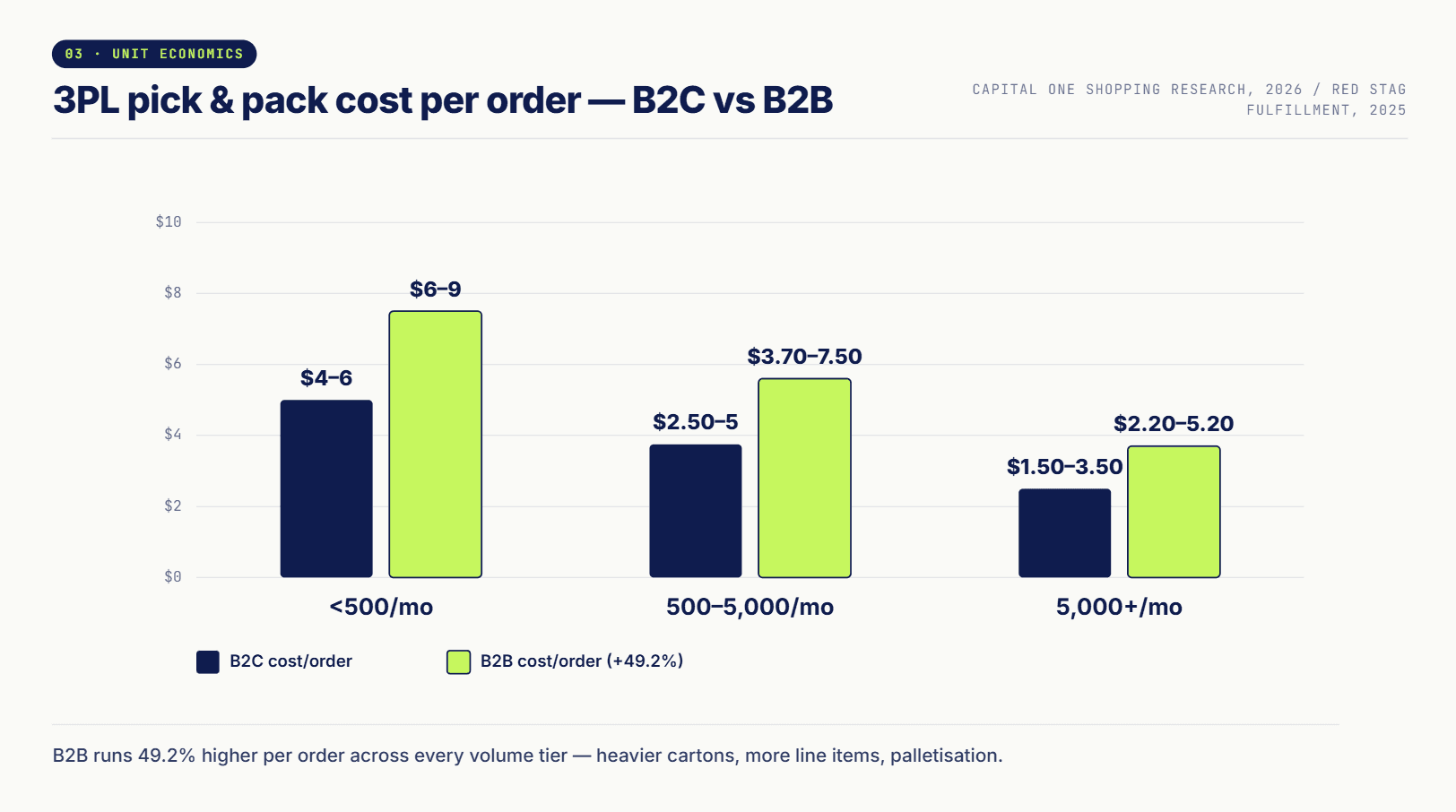
In-house vs. 3PL cost comparison
The numbers shift depending on order volume. Here's the trade-off at three tiers:
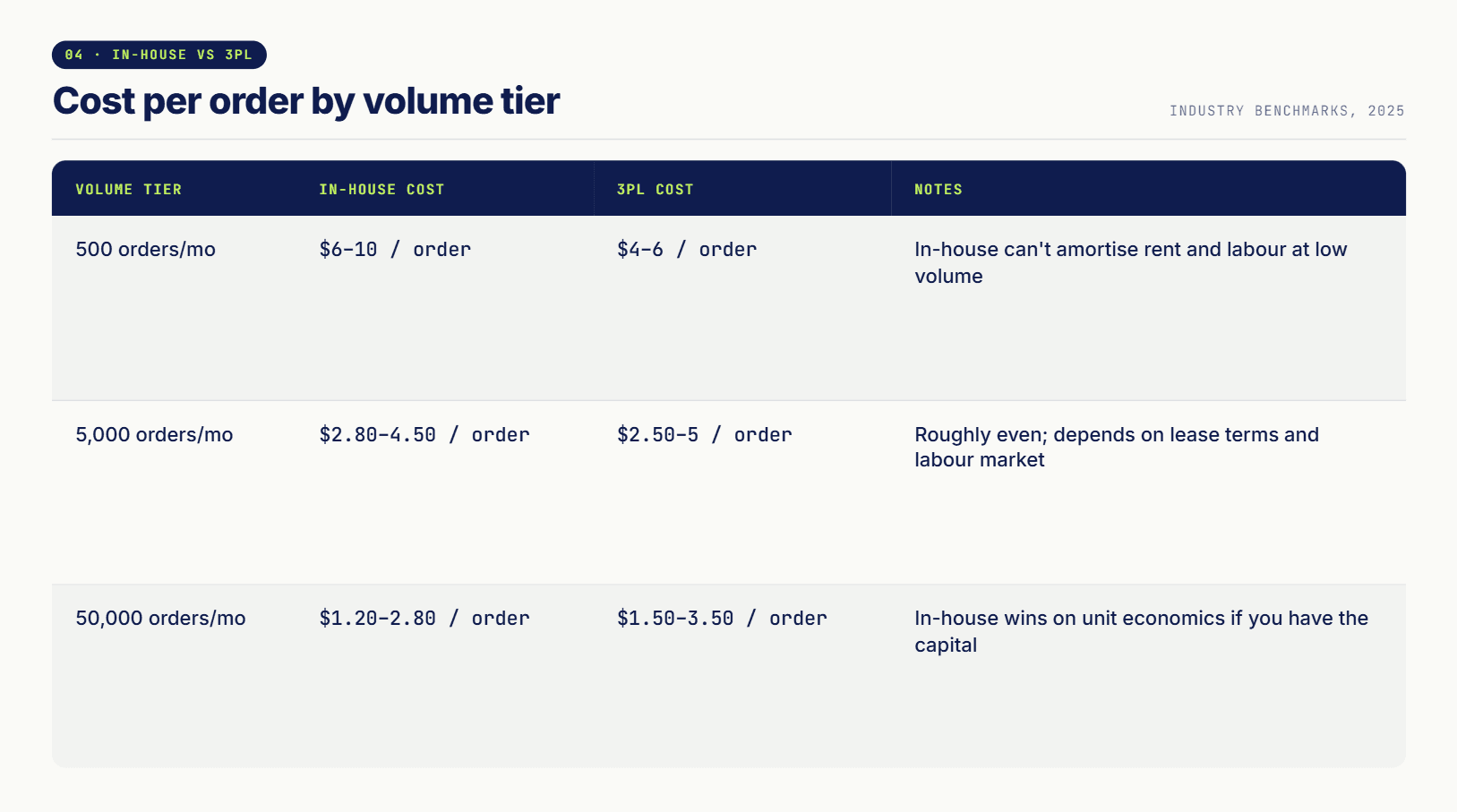
In-house cost assumptions: warehouse labour at 45–57% of total operating expenditure, average US warehouse hourly wage of $25.50, and 1.9M+ workers employed across the sector (Speed Commerce, 2024). Add lease, utilities, WMS licensing, packaging materials, and management overhead.
Hidden cost factors
Most cost overruns in 3PL contracts come from line items that don't appear in the per-order quote:
Dimensional weight fees: If your packaging is oversized for the contents, you're paying for air.
Returns processing: Often quoted separately at $2–$5 per return. Build the maths on your actual return rate, not the industry average.
Long-term storage fees: Most 3PLs charge a premium for inventory that sits longer than 6–12 months.
Special handling: Kitting, bundling, gift wrapping, custom inserts. Quoted per touch.
Peak surcharges: Many 3PLs add 10–25% during November–December to cover labour and capacity. Get this in the contract before you sign.
Pick and pack technology: from barcode scanners to warehouse robots
Warehouse automation is accelerating. Gartner projects over 75% of companies will have adopted some form of cyber-physical warehouse automation by 2027 (GlobeNewswire, 2023). The global warehouse robotics market is on track to grow from $14.7 billion in 2024 to $117.3 billion by 2034 at a 23.1% CAGR, with approximately 450,000 robotic units shipped in 2025 alone (GM Insights).
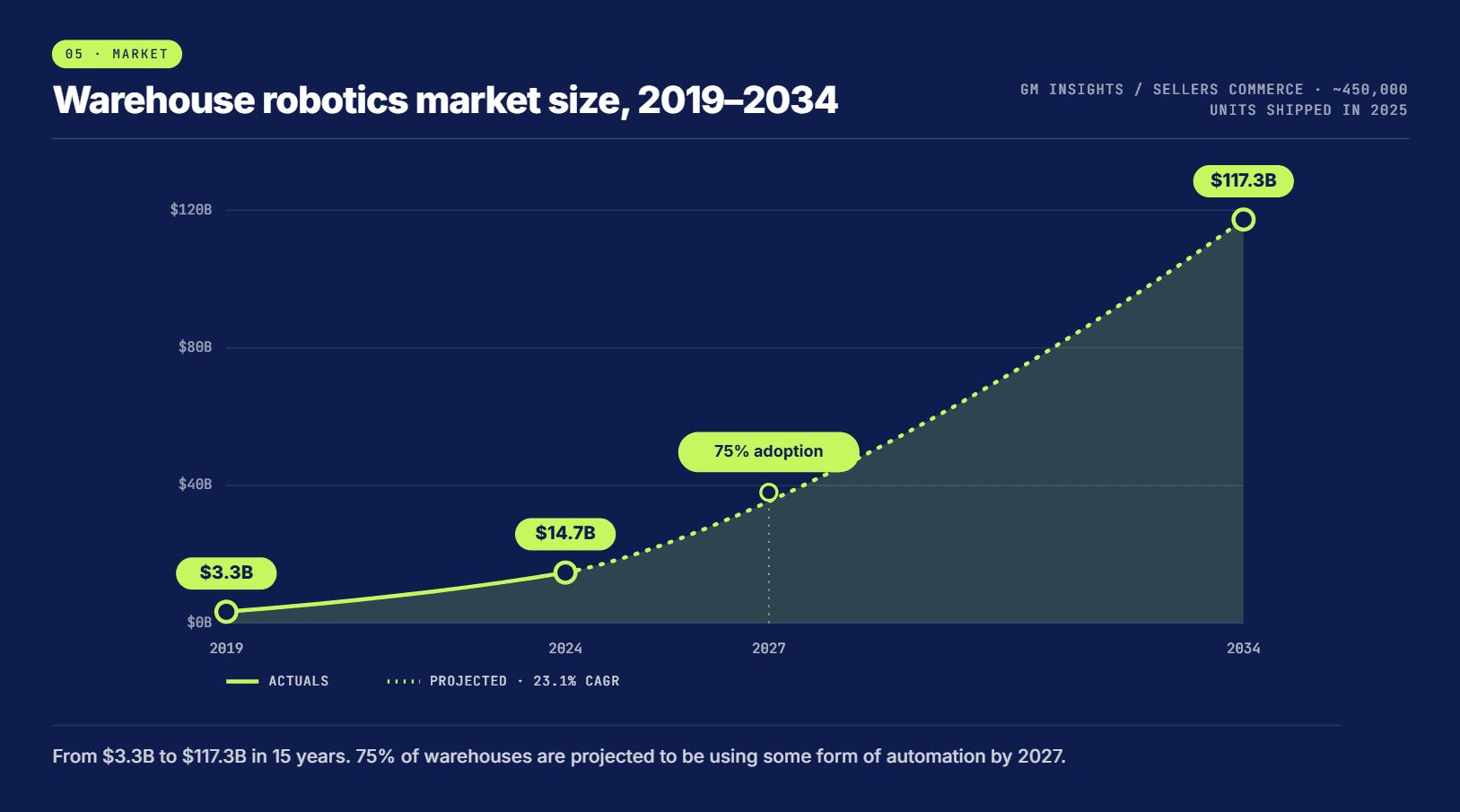
For most e-commerce brands, the relevant question isn't whether to invest in automation. It's whether your 3PL partner has invested in the right tier for your order profile.
Technology stack by investment tier
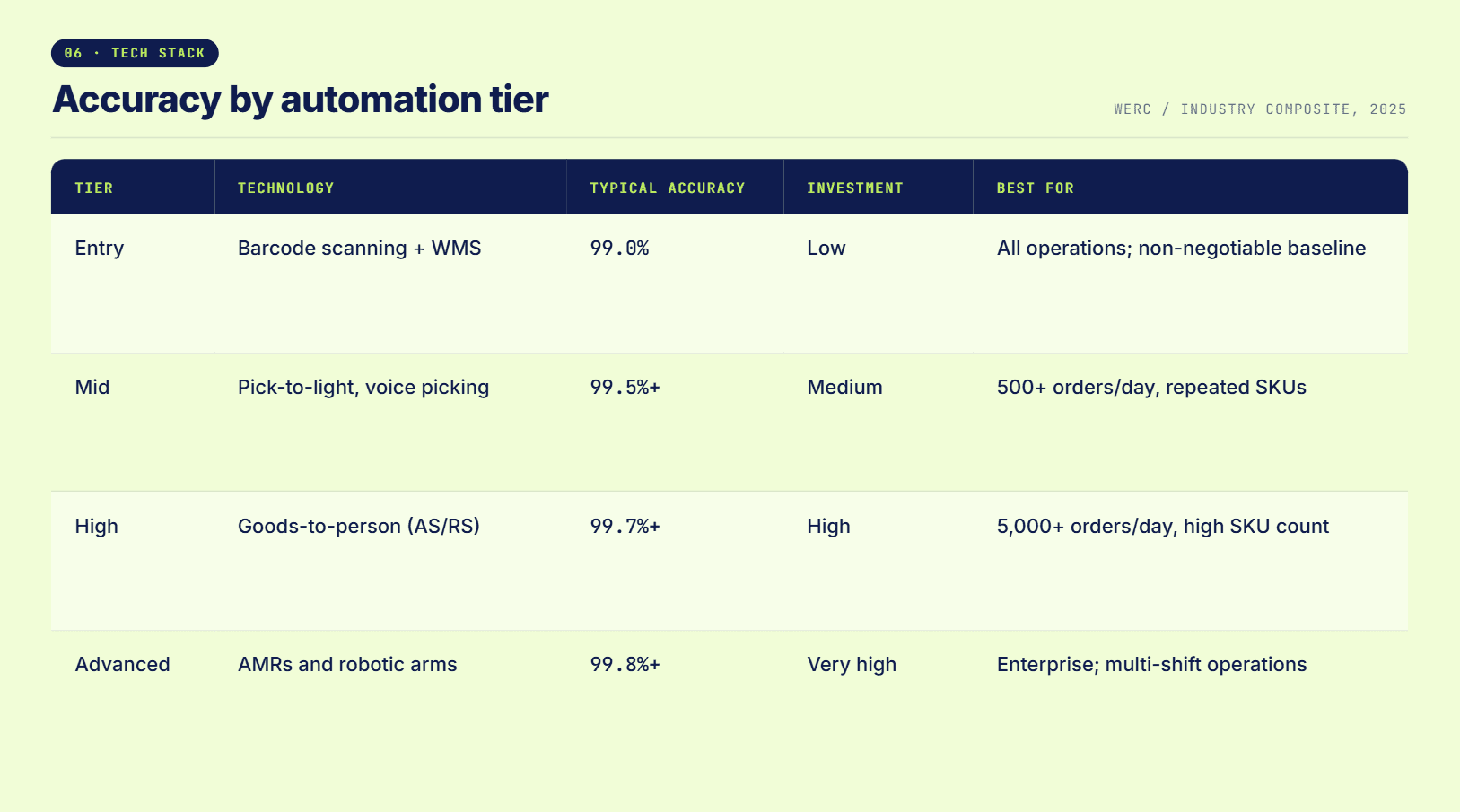
Autonomous Mobile Robots (AMRs) and goods-to-person systems are the highest-impact investments. They cut pick walking time, which (as the cost breakdown earlier showed) is where the majority of pick cost sits. But they don't make sense below roughly 5,000 orders/day. The fixed capital outlay doesn't amortise.
Should you outsource pick and pack to a 3PL?
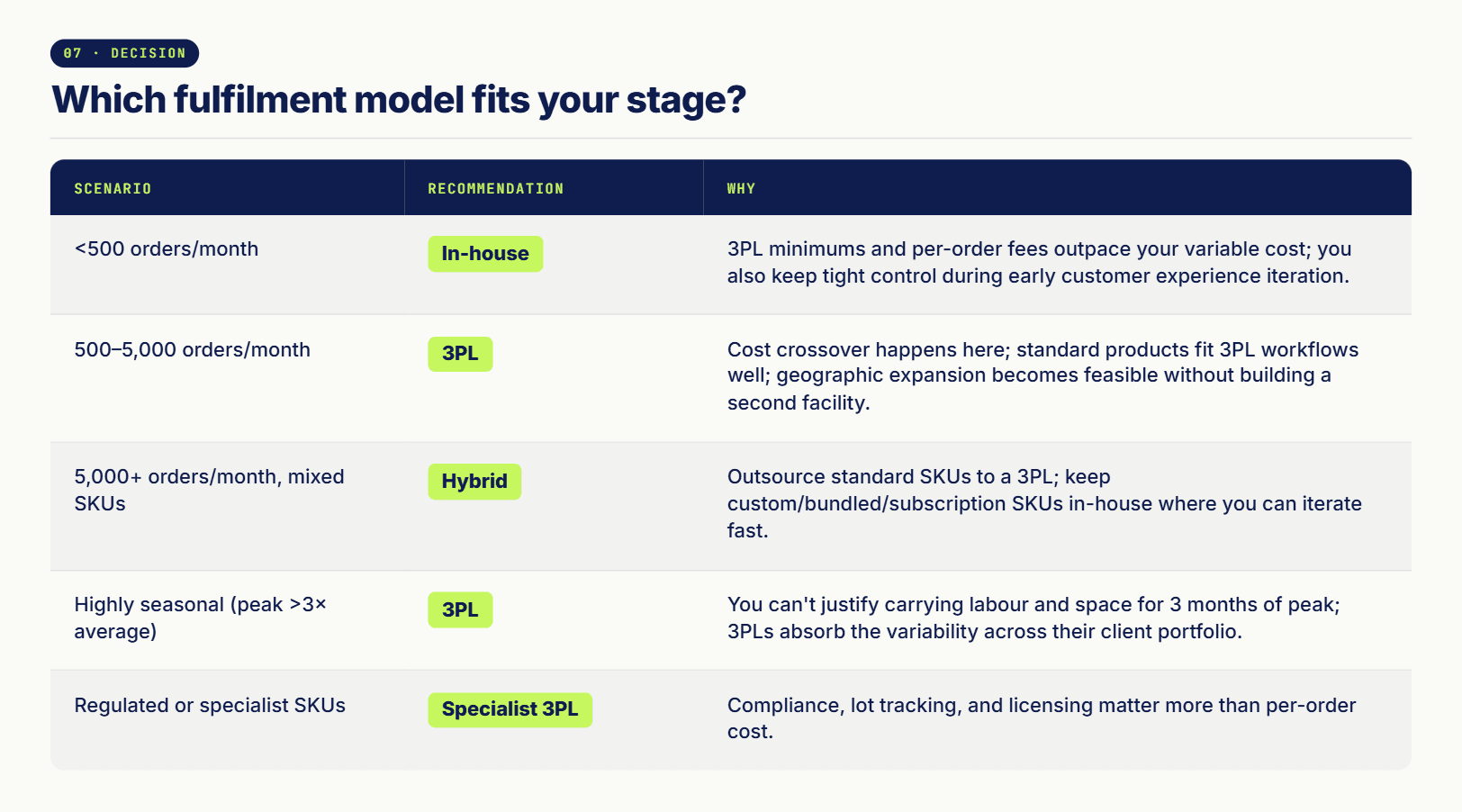
The global 3PL market was valued at $1.2–$1.5 trillion in 2024 and is projected to reach $2.14 trillion by 2030 at approximately 10% CAGR (Fortune Business Insights, 2024). For most e-commerce brands, outsourcing becomes cost-competitive with in-house fulfilment at around 500–1,000 monthly orders. After that, 3PL economies of scale typically outperform the variable cost of in-house labour and space.
The decision isn't purely about cost. It's about where you want your capital and attention to sit.
The decision matrix
Questions worth answering before you outsource
1) What's your current pick error rate, measured the same way the 3PL will measure theirs?
If you don't know, fix that first. You can't benchmark against a provider if you can't measure your baseline.
2) What's your peak-to-trough volume ratio?
A brand that does 80% of its sales in Q4 has a fundamentally different fulfilment problem than one that runs flat year-round.
3) Where do your customers actually live?
A 3PL with the wrong footprint will save you per-order cost and lose it back in shipping zones.
4) What's your SKU velocity profile?
80/20 distributions (a handful of SKUs driving most of the volume) are easier to outsource than long-tail catalogues.
5) What does your returns processing workload look like?
If returns are >10% of orders, the 3PL's reverse logistics capability matters as much as their forward pick rate.
For e-commerce brands evaluating providers, the matching criteria that actually move the needle aren't the ones on most 3PL websites. They're carrier mix, footprint, SKU velocity fit, peak elasticity, and provable accuracy on similar-profile clients. Most brands on the platform receive their first quote from a matched 3PL within 48 hours, and we screen providers against those criteria before we make the introduction.
FAQs
What is pick and pack in a warehouse?
Pick and pack is the fulfilment process where individual items are retrieved (picked) from inventory and packaged (packed) for shipment. It follows four steps: order receipt, picking, packing, and shipment. It's the operational backbone of e-commerce, in a market valued at $141.35 billion in 2025 and projected to reach $468.44 billion by 2034 (Precedence Research).
How much does pick and pack fulfilment cost?
For most small to mid-sized e-commerce brands using a 3PL, pick and pack costs $2.50–$5.00 per order. The average B2C pick and pack fee is $4.05 per item, while B2B is 49.2% more expensive due to compliance labelling and routing guide requirements (Capital One Shopping Research, 2026). High-volume operations (5,000+ orders/month) typically see rates of $1.50–$3.50 per order.
What is a good pick and pack accuracy rate?
Best-in-class warehouses operate at 99.5%+ accuracy. The industry average is 97–99%, meaning 1–3 errors per 100 orders. Over 35% of warehouses run at an error rate of 1% or worse (Canadian Alliance / Staci Americas, 2024). At 500,000 annual orders, the gap between 97% and 99.5% accuracy is 12,500 mis-packs a year.
What are the four main warehouse picking methods?
Piece picking (one worker, one order at a time; best for <50 orders/day), batch picking (one worker, multiple orders simultaneously; best for 50–200 orders/day), zone picking (workers assigned to warehouse zones; best for 500+ orders/day), and wave picking (scheduled batch releases across zones; best for high-volume, multi-channel operations).
When should a business outsource pick and pack to a 3PL?
For most e-commerce brands, outsourcing becomes cost-competitive at around 500–1,000 monthly orders. Under that, in-house is often cheaper and gives you tighter control. Above 5,000 orders/month with a mixed SKU profile, a hybrid model (3PL for standard SKUs, in-house for custom) usually wins. Highly seasonal brands and those with regulated SKUs typically outsource earlier.
Highlights
Order picking accounts for 55%+ of warehouse operating expenditure. Method selection and accuracy rate are the two biggest cost levers.
Industry average pick error rate is 1–3%; best-in-class is 99.5%+. At 500,000 annual orders, that gap is 12,500 mis-packs a year.
3PL pick and pack becomes cost-competitive around 500–1,000 monthly orders. B2B runs 49.2% more expensive than B2C.
Warehouse automation is on track for 75%+ adoption by 2027, but the right tier depends on your volume profile.
The 3PL provider you match with matters more than the technology they run. Provable accuracy, the right carrier mix, and the right footprint outperform marketing claims about robots and AI.
If you're an e-commerce brand trying to figure out whether your fulfilment is costing you more than it should, the fastest way to find out is to compare your current per-order cost and error rate against providers that match your volume tier and SKU profile. We do that match for you, with platform data on real provider performance.