What is a 3PL, and how does it work?
Table of contents
Share
Every ecommerce brand hits the same inflection point. Packing orders in a spare room stops being resourceful and starts costing sales. Delivery promises slip, stock counts drift, and the founder who should be building the business is spending three hours a day taping boxes. That’s usually the moment someone types “what is a 3PL?” into Google.
The problem is that the 3PL market is fragmented and difficult to compare. There are tens of thousands of providers globally, no standard pricing model, and very little transparency around service quality. Most founders make their first 3PL decision with incomplete information, and many get it wrong.
This guide covers exactly what a 3PL is, how they work, what it costs, how it compares to doing everything yourself, and how to choose the right provider.
What is a 3PL? (3PL definition and meaning)
A 3PL, or Third-Party Logistics (3PL) provider, is a company that manages the physical fulfilment of your orders on your behalf. You send your stock to their warehouse. They store it, pick it, pack it, and ship it to your customers when orders come in.
The “third party” part of the name refers to the provider’s position in the supply chain. You (the seller) are the first party. Your customer (the buyer) is the second. The 3PL sits between you, handling the logistics that connect your product to your customer’s doorstep.

It’s also worth being clear about what a 3PL is not. A 3PL isn’t a courier. Couriers like Royal Mail, DPD, or Evri collect and deliver parcels, but they don’t store your stock or pack your orders. A 3PL isn’t a freight forwarder either. Freight forwarders move bulk goods between countries, typically at the container or pallet level. And while Amazon FBA operates as a type of 3PL model, it comes with marketplace dependency, fee structures, and branding restrictions that make it a fundamentally different proposition to working with an independent provider.
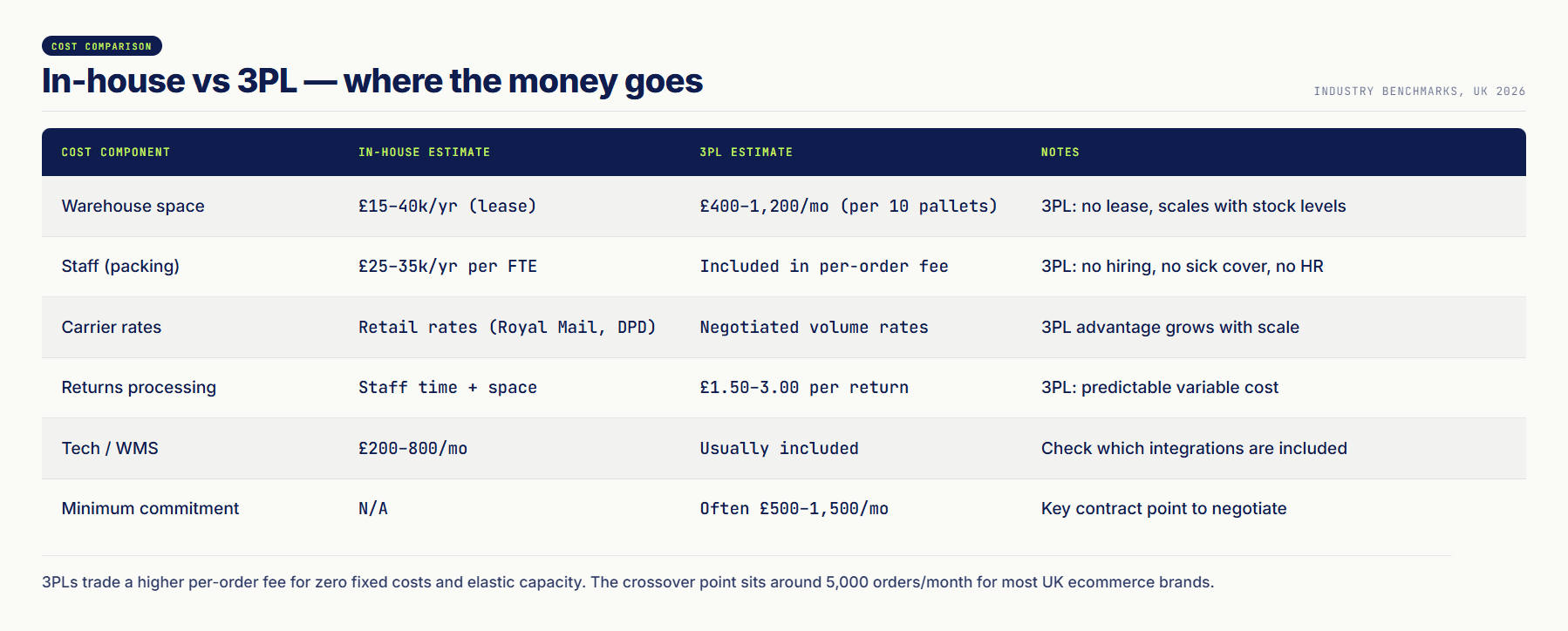
The core value proposition of a 3PL is straightforward: you trade fixed costs for variable costs. Instead of signing a warehouse lease, hiring packing staff, and buying equipment to set up an in-house fulfilment operation, you pay per order fulfilled and per pallet stored. Your logistics costs scale with your sales, not ahead of them.
In the supply chain, a 3PL sits between your manufacturer and your customer. Product moves from factory to 3PL warehouse, and from there, directly to the end buyer. For most direct-to-consumer ecommerce brands, that’s the entire physical distribution model.
The market is significant. The global third-party logistics market was valued at $1.3 trillion in 2024 and is projected to reach $2.14 trillion by 2030 at approximately 10% compound annual growth (Fortune Business Insights, 2025). That growth is driven almost entirely by ecommerce: global online retail sales hit $6.88 trillion in 2026, representing 21.1% of all retail (Capital One Shopping, 2026).
What does a 3PL actually do?
A 3PL takes on six core operational functions that would otherwise require a lease, a workforce, and significant capital expenditure from your brand.
1. Inbound receiving
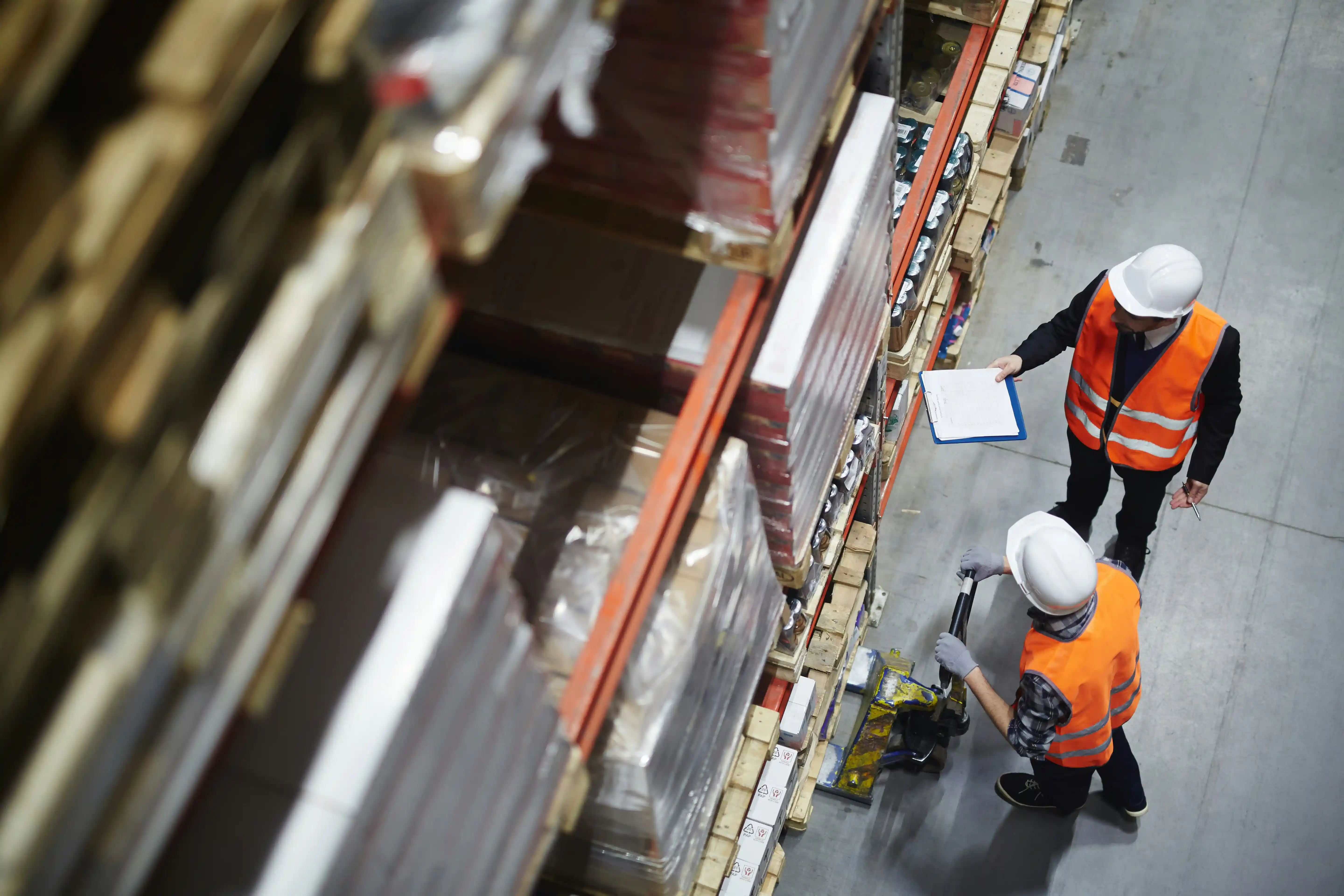
When your manufacturer ships stock, the 3PL receives it at their warehouse. This means unloading pallets, checking quantities against your purchase order, logging each SKU into their Warehouse Management System (WMS), and flagging any discrepancies. Receiving errors here create downstream problems, so this step matters more than most brands realise. If stock arrives mislabelled or short-shipped and nobody catches it, your inventory counts are wrong from day one.
2. Storage
Your inventory is physically held in the 3PL’s facility. Depending on your product type, that could be standard racked shelving, ambient-controlled space, temperature-regulated cold storage, or specialist secure areas for high-value goods. You typically pay per pallet position or per cubic metre, charged weekly or monthly.
3. Order processing
The 3PL integrates with your ecommerce platform Shopify, WooCommerce, Amazon, TikTok Shop, and others) so that new orders are automatically pushed to the warehouse floor. There’s no manual step. When a customer places an order on your website at 2am, the 3PL’s system receives it in real time and queues it for the next pick run.
4. Pick and pack
Warehouse staff physically retrieve the correct items from storage (pick) and package them to your specifications (pack). This includes branded packaging, tissue paper, marketing inserts, and kitting or bundling if you sell multi-item sets. Pick and pack is the most labour-intensive part of the fulfilment process, and order picking alone accounts for more than 55% of total warehouse operating costs (Taylor & Francis / Georgia Tech, 2023).
5. Shipping
The packed parcel is dispatched through the 3PL’s carrier network. Because 3PLs ship high volumes across many clients, they access negotiated carrier rates that most individual brands can’t match. This is often one of the clearest financial benefits of outsourcing: you get the bulk shipping discount without having to generate the bulk volume yourself.
6. Returns management
Returned parcels arrive at the 3PL’s warehouse, where staff inspect each item, determine whether it’s resaleable, and reintegrate viable stock into your inventory. Returns processing is expensive and labour-intensive to run in-house, and it’s one of the services brands most frequently underestimate when costing their own fulfilment operation.
In matching hundreds of brands with 3PL partners, we see the same sticking points come up repeatedly: carrier rate transparency, the true cost of returns handling, and whether branded packaging is included or charged as an add-on. If you’re evaluating 3PLs, those three areas deserve the closest attention.
How does 3PL pricing work?
3PL pricing has no industry standard, which is one of the main reasons brands find it difficult to compare providers. Most 3PLs charge a combination of setup fees, storage fees, and per-order fulfilment fees, but the structure and naming varies significantly from one provider to the next.
Storage fees
Charged per pallet, per shelf, or per cubic metre, typically on a weekly or monthly basis. In the UK, the average sits between £8.00 and £20.00 per pallet per week, depending on your product type and the warehouse location (fulfilment.com platform data, 2025). Temperature-controlled and hazardous goods storage sits at the higher end.
Pick and pack fees
A per-order fee covering the labour cost of picking items from storage and packing the parcel. The typical range for standard UK ecommerce is £1.50 to £4.00 per order, plus a per-item fee for multi-SKU orders. B2B fulfilment costs more: the average B2C pick and pack fee is $4.05 per order, while B2B runs 49.2% higher due to compliance labelling, routing requirements, and pallet configuration (Capital One Shopping Research, 2026).
Shipping fees
Usually passed through at the 3PL’s negotiated carrier rate plus a small handling margin. For many brands, the 3PL’s carrier rates are lower than what you’d pay shipping on your own, because the 3PL’s total parcel volume across all clients gives them buying power with carriers like Royal Mail, DPD, Evri, and DHL.
Additional charges to watch for
Inbound receiving fees (per pallet or per delivery), returns processing fees (£1.50 to £3.00 per return is common), kitting and assembly fees, minimum monthly spend commitments, and contract exit penalties. The minimum spend is particularly important to understand: a headline rate of £1.50 per order with a £2,000 monthly minimum means you’re paying that minimum regardless of volume until you’re processing enough orders to exceed it.
3PL vs 4PL: What’s the difference?
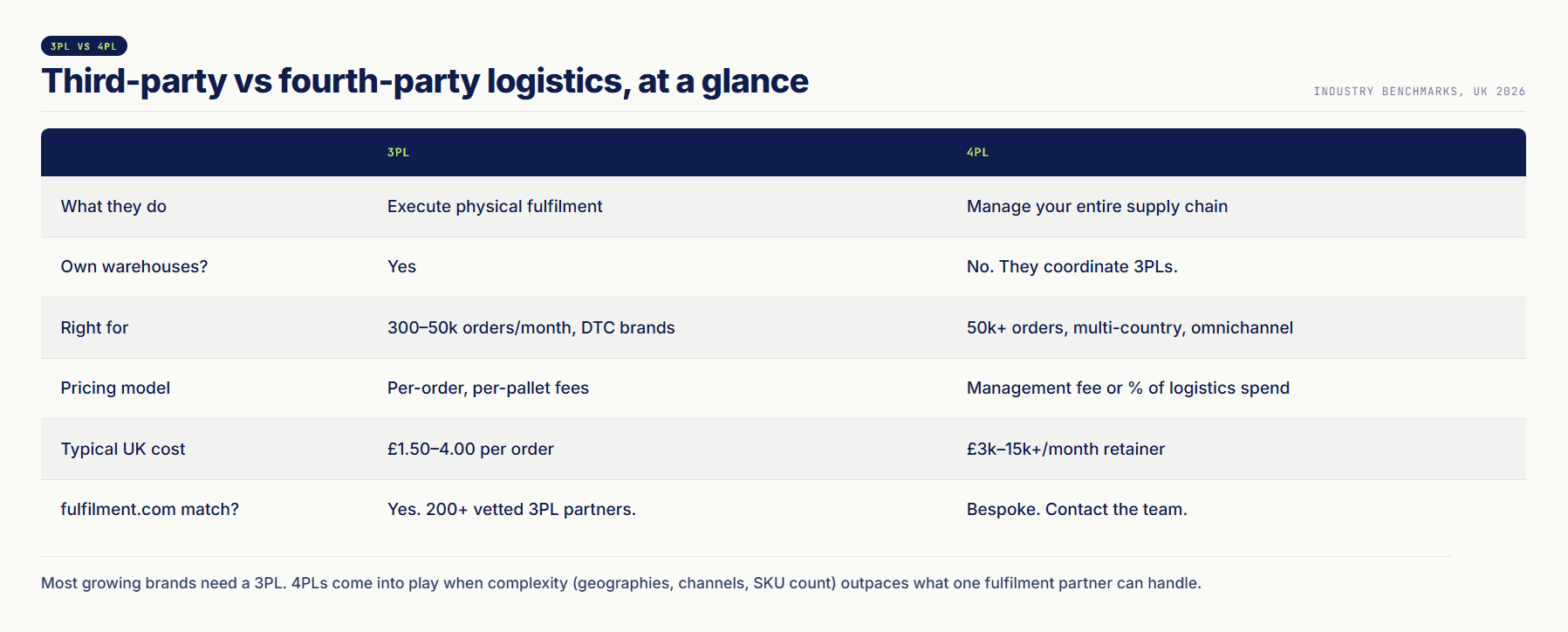
A 3PL executes your logistics. They physically handle your stock, pack your orders, and ship them. A 4PL (Fourth-Party Logistics provider) manages your entire supply chain on your behalf, including the relationship with one or more 3PLs. If a 3PL is your warehouse, a 4PL is your logistics director.
A 4PL doesn’t typically own warehouse space. Instead, they sit above the 3PL layer and coordinate multiple providers, carriers, and freight routes to optimise your end-to-end supply chain. They’re strategic, not operational.
For most ecommerce brands doing fewer than 50,000 orders per month and selling primarily direct-to-consumer in one or two countries, a 3PL is the right model. The cost is lower, the relationship is simpler, and you retain direct visibility of your stock and fulfilment performance.
A 4PL starts to make sense when you’re operating across multiple countries, managing both DTC and wholesale channels, or coordinating several 3PLs simultaneously. At that complexity, having a single point of accountability for the whole chain can reduce cost and operational risk.
FAQs
What is a 3PL?
A 3PL (Third-Party Logistics) provider is a company that manages warehousing, order fulfilment, and shipping on behalf of ecommerce brands. You send them your stock; they store it, pick and pack orders when they come in, and dispatch them using their carrier network. You pay per order and per pallet, with no lease and no staff.
What does 3PL stand for?
3PL stands for Third-Party Logistics. The “third-party” refers to the fact that the provider is external to the buyer-seller relationship: a separate company that handles the physical logistics between your brand (the seller) and your customers (the buyers).
What is the difference between a 3PL and a 4PL?
A 3PL physically handles your fulfilment. They warehouse your stock and ship your orders. A 4PL manages your entire supply chain strategy, often coordinating multiple 3PLs on your behalf. Most ecommerce brands processing fewer than 50,000 monthly orders need a 3PL, not a 4PL.
How much does a 3PL cost?
3PL costs vary widely, but most UK ecommerce brands pay £1.50–4.00 per order in pick and pack fees, plus £8–20 per pallet per week in storage. Your total monthly cost depends on order volume, SKU count, average order weight, and returns rate.
When should I use a 3PL?
Most ecommerce brands benefit from a 3PL at 300–500 monthly orders. Below that, in-house fulfilment is usually cheaper. The key signals are: fulfilment is consuming more than 10% of your team’s time, you’re expanding into a new geography, or your order accuracy rate is declining.